

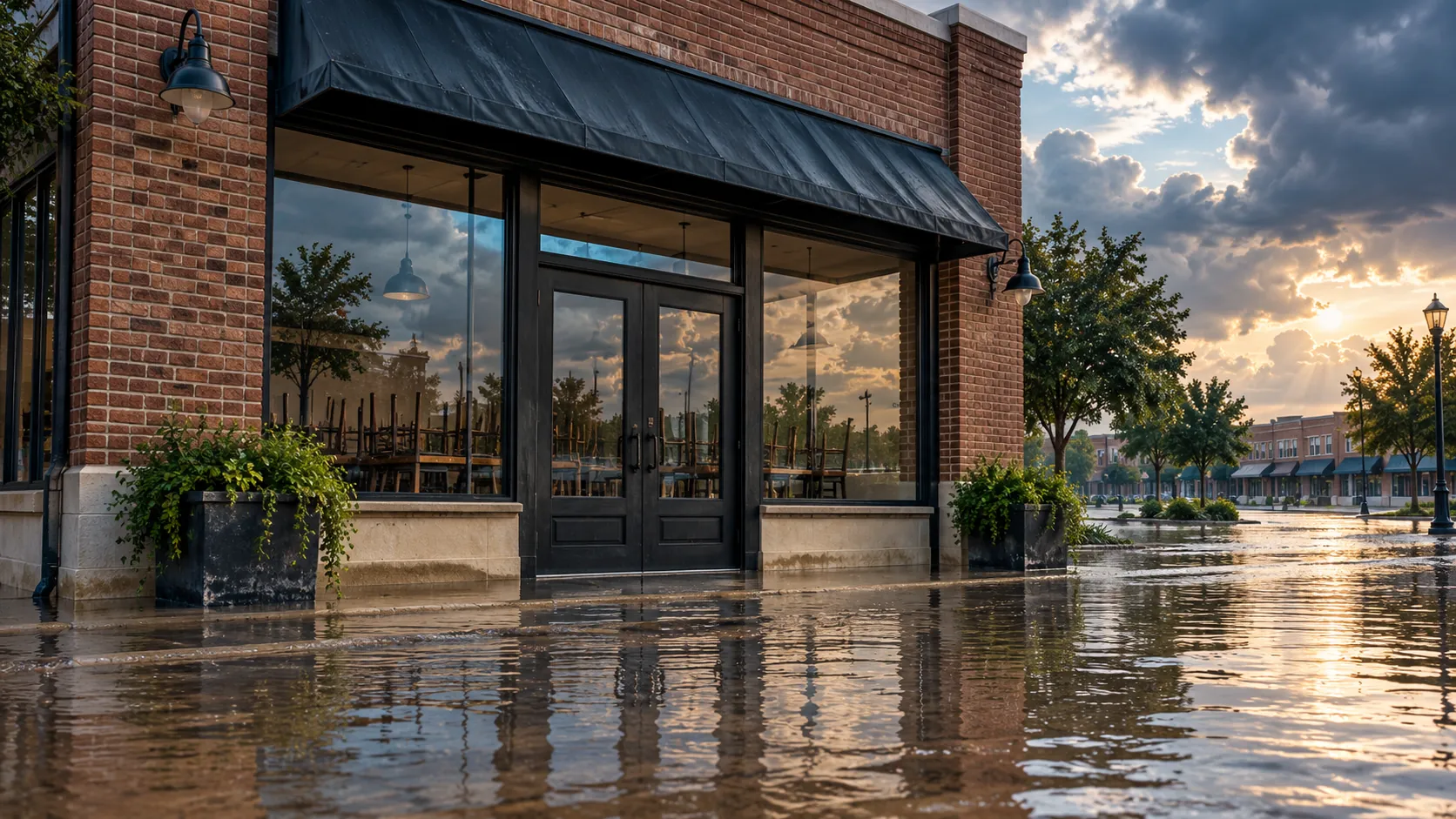
Your shop floods. The doors stay closed. Customers stop coming—but your bills keep arriving.
You have business insurance. You may even have flood insurance. Does either one replace the income you lose while you recover?
Texas business flood insurance can help with covered damage to your building and contents, but an NFIP flood policy does not cover business interruption or loss of use. That distinction deserves a place in your next insurance review, especially if your business depends on a physical location, inventory, or equipment.
Key takeaways
- Most commercial property policies exclude flood; flood protection generally requires a separate policy or specifically arranged coverage.
- NFIP flood insurance treats building and contents as separate coverages and excludes business interruption (lost income).
- Business income coverage generally responds only after physical damage from a covered cause, so a flood shutdown is not automatically covered.
- New NFIP policies generally have a 30-day waiting period, so buying coverage when rain is forecast is too late to rely on.
- Tenants should review their own contents, equipment, and improvements; a landlord’s policy may not cover them.
Why Texas business owners should revisit this question now
On October 28, 2026, the Texas Division of Emergency Management announced the activation of emergency response resources ahead of heavy rainfall and potential flash flooding in portions of West and South-Central Texas. Read the state’s announcement.
That announcement concerns those regions; it is not a forecast for Baytown, Beaumont, Port Arthur, or Groves. For Southeast Texas business owners, however, it offers a timely reason to ask a practical question: What would happen to our cash flow if water kept us closed? Follow current local forecasts and official instructions for conditions at your location.
Does business insurance cover flood damage in Texas?
Most commercial property policies exclude flooding, according to the Texas Department of Insurance’s commercial property guide. Flood protection generally requires a separate policy or specifically arranged coverage.
Start with two questions: What caused the water damage, and what does the policy actually cover? A burst pipe and rising floodwater can lead to very different coverage decisions. The phrase “water damage” alone does not answer either question.
Ask your agent to identify flood exclusions, covered property, limits, and deductibles in your actual policies. A certificate showing that you carry business insurance is not a substitute for reviewing those terms.
Does flood insurance cover lost business income?
The National Flood Insurance Program’s business guidance explains that building and contents protection are separate purchases. Contents can include business inventory and equipment, subject to the policy’s terms. NFIP coverage excludes business interruption and loss of use.
That creates two separate planning questions:
- Property: What insurance could help repair the premises or replace damaged business property?
- Income: What resources would keep the business financially stable while operations are interrupted?
Business income coverage also has conditions. As the National Association of Insurance Commissioners explains, it generally responds to interrupted operations following physical damage from a covered event. Having business income coverage does not automatically make a flood-related shutdown covered.
Ask whether flood-related business income or extra expense protection is available for your operation and how its trigger, waiting period, limits, and exclusions work. Availability and terms vary; do not assume an option exists until it has been confirmed.
A repair bill is only part of the story: planning for downtime
Consider a hypothetical neighborhood retailer. Floodwater damages shelving and inventory, and the store cannot reopen for two weeks. Even if an applicable policy helps with covered property damage, the owner still needs a plan for the interruption.
Before a loss, the owner could estimate:
- Which expenses continue while the store is closed?
- Can sales move online or to another location?
- How quickly can suppliers replace inventory?
- How long would available cash support the business?
These are planning questions—not a prediction of what a claim would pay. A useful insurance review connects policy terms with the way your business actually earns money.
Renting your location? Review your own property, too
If you lease a storefront, office, or workshop, ask your landlord what the building’s insurance covers. Then review your own inventory, furniture, equipment, and improvements with your agent.
Do not assume that a landlord’s policy protects everything you use to run your business. Bring your lease and current policies to the conversation so responsibilities can be checked together.
For a contractor, make a separate list of tools, equipment, vehicles, and items stored away from the main premises. Ask where each item is insured and what flood restrictions apply. A single address on a policy should not end the discussion about property used across multiple jobsites.
Is there a waiting period for business flood insurance?
Can you buy flood insurance when rain is already forecast? Do not rely on last-minute purchasing. New NFIP policies generally have a 30-day waiting period, with exceptions for certain circumstances. FloodSmart, the NFIP’s official website, explains purchasing and waiting periods.
Private flood policies may have different terms. Confirm the effective date and any restrictions before relying on coverage. Buying insurance does not make an existing loss covered.
Five questions to bring to your coverage review
- Is flood covered at each business location, and where is that coverage written?
- Are both the building and my business contents addressed?
- What limits, deductibles, exclusions, and effective dates apply?
- Would business income coverage respond if flooding caused the shutdown?
- What cash reserves and operating alternatives would we need for expenses insurance does not cover?
You do not need to know every insurance term before asking these questions. Bring your declarations pages, property details, and a short explanation of how your business operates.
Texas business flood insurance FAQ
Does NFIP flood insurance cover business interruption?
No. NFIP flood policies exclude business interruption and loss of use. They can help with covered physical damage to the building and, if purchased, business contents such as inventory and equipment.
How much commercial flood coverage can the NFIP provide?
For non-residential buildings, NFIP limits are up to $500,000 for the building and up to $500,000 for contents. Businesses with higher values may ask whether private or excess flood coverage is available.
Does my commercial property policy cover flooding?
Usually not. Most commercial property policies exclude flood. Check the exclusions in your actual policy, because damage from a burst pipe and damage from rising floodwater are often treated differently.
Do I need flood coverage if I rent my business location?
The landlord’s policy may cover the building, but your inventory, furniture, equipment, and improvements may be your responsibility. Review your lease and your own policies with your agent.
Get a business insurance review in Southeast Texas
Trevco Insurance Agency has served Texas since 1990, with offices in Baytown, Beaumont, and Groves serving the Port Arthur area. As an independent agency, we can help you compare available options and understand how coverage fits your operation. For an overview of the protection most companies consider, see our guide to business and commercial insurance.
Explore our commercial insurance options or request a business insurance review. Tell us you would like to discuss flood coverage and business income protection.
Before your next renewal, find out who would pay for the damage—and how you would handle the downtime. Not sure when that is? Read when an insurance policy renews.
This article provides general information. Coverage depends on the policy’s terms, conditions, exclusions, limits, and underwriting. Examples are hypothetical and do not guarantee coverage or claim payment.
